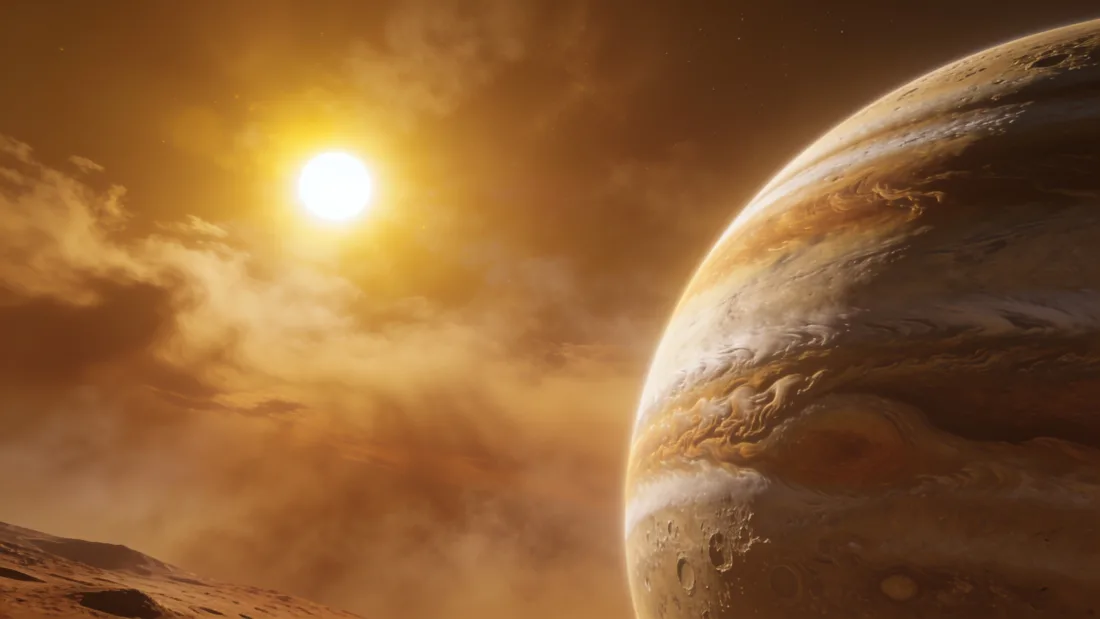
Three hundred and thirty-two light-years away, a star called TOI-5624 holds at least five planets in its orbit. One of them, TOI-5624 e, was discovered in 2026 using a clever trick of light and shadow. Scientists didn’t see the planet directly — they caught it passing in front of its star.
What Kind of World Is TOI-5624 e?
TOI-5624 e is larger and heavier than Earth, but it isn’t a giant like Jupiter. Its radius — that means how wide it is from center to edge — is about 3.25 times Earth’s radius. Its mass, meaning how much matter it contains, is about 8.9 times Earth’s mass. That puts it in a category scientists often call a sub-Neptune: bigger than a rocky planet like Earth, but smaller than an ice giant like Neptune.
Planets in this size range are interesting because scientists aren’t always sure what they’re made of. TOI-5624 e could have a rocky core wrapped in a thick atmosphere of gas. Or it might hold large amounts of water mixed with rock and ice deep inside. Scientists haven’t been able to measure its exact makeup yet.
What does seem clear is that this world is very hot. Its estimated temperature is around 614 Kelvin — that’s roughly 341 degrees Celsius. To put that in perspective, lead melts at about 327 degrees Celsius. So if there were any lead on the surface of TOI-5624 e, it would be a liquid. This high temperature comes from how close the planet sits to its star. It completes one full orbit — one “year” — in just 21.5 Earth days. That’s a very tight, fast path around its sun.
The Transit Method: How a Shadow Tells a Big Story

So how did astronomers find a planet they cannot see directly? They used something called the transit method. A transit happens when a planet passes in front of its star, from our point of view here on Earth. When that occurs, the planet blocks a tiny fraction of the star’s light.
Imagine holding a marble in front of a bright lamp across the room. The lamp dims just a little. That tiny dip in brightness is the signal scientists look for. In real astronomy, the dip can be less than one percent of the star’s total light — sometimes much less. It takes very sensitive space telescopes to notice it.
Here is how the process works, step by step:
- A telescope watches a star steadily over days, weeks, or months, measuring its brightness again and again.
- The brightness dips slightly at a regular interval — the same dip, the same amount, each time.
- Scientists check whether the dip could be caused by something else, like a second star or a sensor glitch. If it keeps happening on a regular schedule, a planet is the most likely explanation.
- The size of the dip tells scientists how big the planet is compared to the star. A larger planet blocks more light, making the dip deeper.
- The time between dips tells scientists how long the planet takes to orbit — its year length.
For TOI-5624 e, the dip repeated every 21.5 days. That’s how scientists knew its orbital period. The depth of the dip gave them the planet’s radius. If you want to explore how this works visually, the planet-finding simulator lets you see the light curve — the graph of brightness over time — in action.
The Wobble Method: Feeling a Planet’s Pull

The transit method is powerful, but on its own it can only tell us the size of a planet. To find its mass, scientists often use a second technique: the radial velocity method, sometimes called the wobble method.
Here’s the idea. A planet’s gravity doesn’t just make it orbit its star — it also tugs the star slightly. The star wobbles back and forth in a tiny circle. When the star moves toward Earth, the light it sends us gets compressed into slightly shorter wavelengths — it looks a little bluer. When the star moves away, the light stretches into longer wavelengths — it looks a little redder. This shift is called the Doppler effect, and it’s the same reason an ambulance siren sounds higher-pitched when it’s coming toward you and lower-pitched when it drives away.
By measuring how much the star’s light shifts, scientists can figure out how strongly the planet is pulling it. A heavier planet causes a bigger wobble. That’s how they estimated the mass of TOI-5624 e at 8.9 times Earth’s mass.
Together, the transit method and the wobble method make a strong team. One gives size, the other gives mass. With both numbers, scientists can estimate the planet’s density — how tightly packed its material is — which helps them guess what it might be made of.
What We Know About TOI-5624 e From the Numbers
The host star, TOI-5624, has a surface temperature of 5,327 Kelvin. Our own Sun sits at about 5,778 Kelvin, so TOI-5624 is a little cooler and likely a little smaller than the Sun, though scientists haven’t confirmed every detail of its size and type in the data we have.
With a radius of 3.25 Earths and a mass of 8.9 Earths, the planet’s density works out to be lower than a purely rocky world but higher than a world mostly made of gas. This is consistent with a planet that has a rocky interior and a fairly thick layer of lighter material — possibly gas, water, or a mix — on top. Scientists think this, but they haven’t confirmed it directly.
The temperature of 614 K almost certainly means the planet sits well inside the region where liquid water could not survive on an open surface. It is too hot. Scientists haven’t measured its atmosphere, so we don’t know whether it even has one.
A Busy Neighborhood: Five Planets Around One Star
TOI-5624 e isn’t alone. As of its discovery, five planets are known to orbit TOI-5624. That makes it a multi-planet system, which is actually quite common among stars studied closely. Finding multiple planets in one system helps scientists understand how planets form and arrange themselves over time.
Scientists haven’t released all the details about the other four planets in the TOI-5624 system in the data available here. What is known is that having several planets close enough to detect suggests the system is well-organized — the planets’ orbits don’t cross each other chaotically, or they likely wouldn’t have lasted this long.
Why This System Is Worth Watching
TOI-5624 e was only discovered in 2026, so it is still a young subject of study. Future observations may reveal more about its atmosphere, its exact composition, and the other planets sharing its star. Sub-Neptunes like this one are among the most common planet types found so far in our galaxy, yet we still have much to learn about them. Every new world like TOI-5624 e adds one more data point to that larger picture — a picture scientists are still carefully drawing, light-year by light-year.