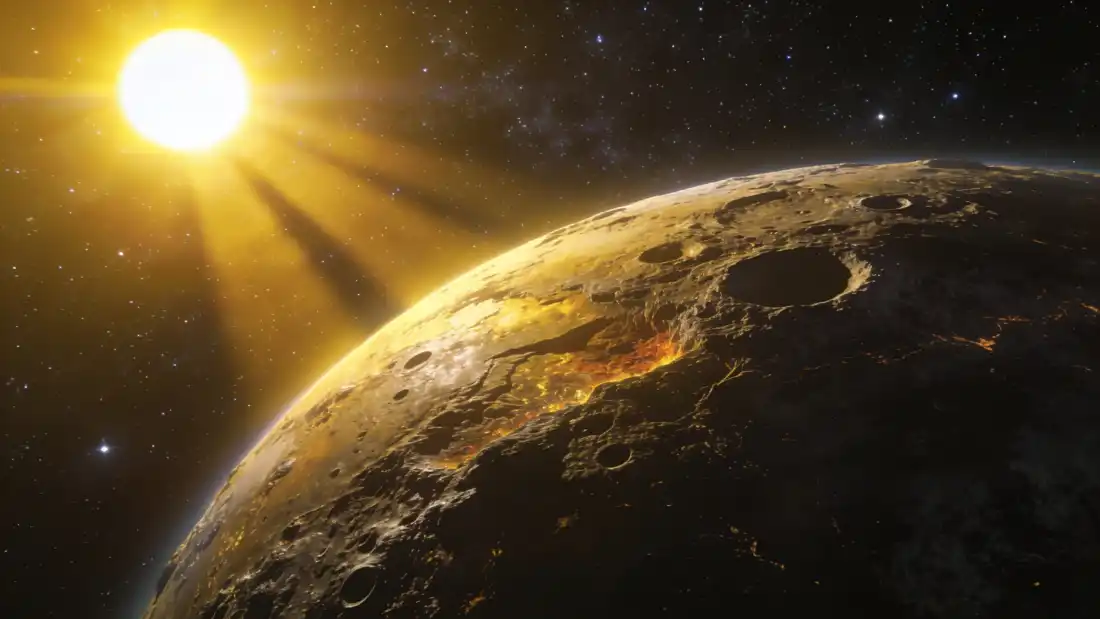
About 88.2 light-years away, a star called HD 158259 hosts a family of five known planets packed surprisingly close together. Astronomers announced this system in 2020, and it has kept scientists busy ever since. One member of the group, HD 158259 f, sits at the outer edge of what we know — and raises some fascinating questions.
Meet the Star HD 158259
HD 158259 is a star in our galaxy, the Milky Way. It sits about 88.2 light-years from Earth. A light-year is the distance light travels in one year — roughly 9.5 trillion kilometers. So even at the speed of light, you would need 88.2 years just to reach this star.
The surface temperature of HD 158259 is 5,802 Kelvin. Kelvin is a temperature scale scientists use — 0 Kelvin is the coldest anything can be, and the Sun’s surface is about 5,778 Kelvin. That makes HD 158259 very similar in temperature to our own Sun. Stars of this kind are called G-type stars, sometimes nicknamed “yellow dwarfs,” though they look closer to white than yellow when seen from space.
Because the star is so similar to our Sun, it is a natural place for scientists to search for planets. Familiar star, familiar conditions — at least in some ways.
How Scientists Found These Planets
The five planets around HD 158259 were discovered in 2020 using a method called radial velocity. Here is how it works. When a planet orbits a star, its gravity gives the star a tiny tug. That tug makes the star wobble very slightly — moving a little toward us, then a little away. As the star moves toward Earth, its light shifts slightly toward the blue end of the color spectrum. As it moves away, the light shifts toward the red end. Scientists can measure these tiny color shifts very carefully. By looking at the pattern of wobbles, they can figure out how many planets are pulling on the star, roughly how massive they are, and how long each orbit takes.
The radial velocity method is very good at measuring a planet’s mass. It is less good at measuring a planet’s size. To get the full picture — both mass and size — scientists often need a second method called the transit method, where they watch to see if the planet passes in front of its star and dims the starlight slightly.
For HD 158259 f, scientists have measured both its mass and its radius, which gives us a more complete portrait of this world than we have for many exoplanets. An exoplanet is simply any planet outside our Solar System.
HD 158259 f — The Outermost Known Planet
HD 158259 f is the fifth and outermost of the five known planets in this system. It completes one full orbit around HD 158259 every 12.0 Earth days. That is an extremely short year compared to Earth’s 365 days. But because HD 158259 f orbits so close to its star, it zips around very quickly.
In terms of size, HD 158259 f has a radius of 2.35 times Earth’s. That puts it in a category scientists call a sub-Neptune — a planet bigger than Earth but smaller than Neptune, our Solar System’s fourth-largest planet. Its mass is 6.14 times Earth’s. With that combination of size and mass, scientists think HD 158259 f is probably a rocky or partially rocky world with a thick envelope of gas or steam surrounding it, though they aren’t certain yet.
Because it orbits so close to its star and completes a full year in only 12 days, HD 158259 f almost certainly experiences intense heat. Scientists haven’t published a confirmed surface temperature for it, so we can’t give you a number — but a planet that close to a Sun-like star would receive far more energy than Earth does. It would not sit in the habitable zone — the range of distances where liquid water could exist on a planet’s surface. Life as we know it would face enormous challenges there.
The Full Family: Five Worlds in Close Formation
What makes HD 158259 especially interesting is not just one planet — it is the whole arrangement. All five known planets orbit their star in a remarkably tight, orderly chain. They are nestled close together, completing their orbits in a matter of days rather than months or years.
This kind of close-packed arrangement is actually common in the galaxy. Many star systems discovered so far have several planets huddled near their star, all completing orbits in just days or weeks. Our own Solar System, where the closest planet to the Sun takes 88 days to orbit and the farthest takes 165 years, is in some ways the unusual one.
Scientists are particularly interested in whether these five planets orbit in a pattern called a resonance — where the orbital periods of neighboring planets form simple ratios, like 2-to-1 or 3-to-2. When planets lock into these rhythms, it suggests they formed slowly and gently, drifting into place over a long time. The HD 158259 planets appear to be close to, but not quite locked into, such resonances. Scientists are still studying why that might be.
How This System Compares to Our Solar System
In our Solar System, the four inner planets — Mercury, Venus, Earth, and Mars — are spread out over a wide range of distances from the Sun. Even Mercury, the closest, takes 88 days to orbit. The planets in HD 158259 pack five worlds into orbits that are all far shorter than Mercury’s year.
Our inner planets are also a mixed group: small, rocky worlds with thin or moderate atmospheres. The HD 158259 planets appear to be mostly sub-Neptunes — larger than Earth and possibly wrapped in thick atmospheres. This is a different recipe entirely. Scientists are not sure whether systems like HD 158259 are more common than systems like ours, or the other way around. So far, the radial velocity and transit methods tend to find planets that are bigger and closer to their stars, simply because those are easier to detect. The full picture of what is “normal” out there is still coming into focus.
What Scientists Are Still Trying to Learn
The HD 158259 system leaves plenty of open questions. Scientists would like to know whether more planets exist farther out — ones too distant or too small to detect with current tools. They also want to understand what the interiors of these worlds look like. Are they mostly rock? Mostly water? A mix? The mass and radius of HD 158259 f give clues, but the answer isn’t settled.
Researchers are also curious about the near-resonance pattern. Understanding why those orbital rhythms didn’t lock in perfectly could reveal a lot about how the system formed and evolved over billions of years.
You can explore this and other planetary systems using our system explorer, which lets you compare families of planets across the galaxy. HD 158259 and its five close-knit worlds remind us that planetary systems come in many shapes — and that our own corner of the universe is just one possibility among a very wide range of arrangements waiting to be understood.