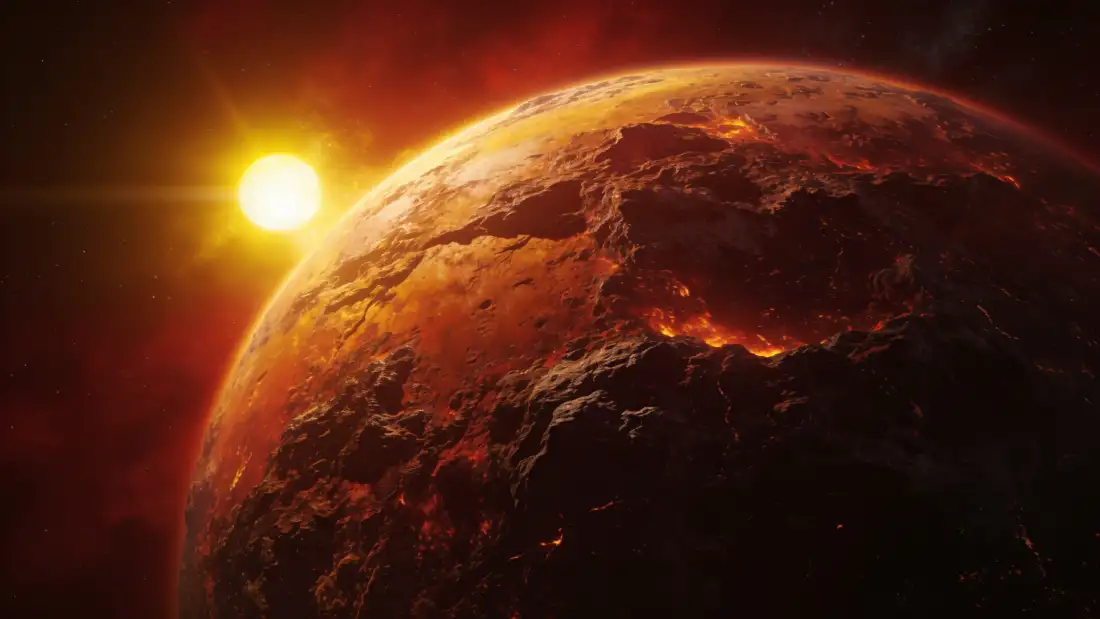
In 2026, astronomers added a new world to our growing list of known planets beyond our solar system. That world is TOI-5624 b, a planet sitting 332 light-years from Earth — a light-year being the distance light travels in a full year, which is almost 9.5 trillion kilometres. It is a fascinating example of a type of planet we have no equivalent of at home.
What Kind of World Is TOI-5624 b?
TOI-5624 b belongs to a category scientists call a mini-Neptune. That simply means a planet smaller than Neptune but much bigger than Earth, and likely wrapped in a thick layer of gas or icy material — quite different from our rocky home world.
The numbers give a clearer picture. TOI-5624 b has a radius 2.31 times Earth’s, so if you could stand it next to our planet, it would look noticeably larger. Its mass is 9.4 times Earth’s, meaning it is much heavier than it looks from size alone. That combination — moderately larger but significantly heavier — tells scientists the planet probably has a dense core, possibly rock or iron, surrounded by a thick envelope of lighter material such as gas or water in some exotic form.
We have nothing quite like this in our own solar system. Earth and Venus are rocky and relatively small. Neptune and Uranus are much larger gas-rich worlds. Mini-Neptunes sit in between, and they turn out to be one of the most common types of planet in the galaxy — even though our solar system skipped them entirely. You can explore more worlds like this in the Atlas.
A Very Short Year
One of the most striking things about TOI-5624 b is how fast it moves. One full orbit around its star — what we would call a year — takes only 3.39 Earth days. That is less than the time it takes some people to finish a long weekend.
Orbiting so close to a star brings serious heat. Scientists estimate the planet’s equilibrium temperature — the average temperature based on how much starlight it receives — is around 1,136 K, which works out to roughly 863 degrees Celsius. That is far hotter than any oven, hotter even than the surface of Venus, the hottest planet in our solar system. At that temperature, any water at the surface would not exist as a liquid. The planet sits nowhere near the habitable zone, the region around a star where temperatures might allow liquid water on a world’s surface.
This does not make TOI-5624 b less interesting to study — quite the opposite. Extremely hot mini-Neptunes can teach scientists a great deal about how atmospheres behave under intense conditions.
The Star It Circles
TOI-5624 b orbits a star called TOI-5624. The star has a surface temperature of 5,327 K. For comparison, our own Sun’s surface sits at around 5,778 K, so TOI-5624 is somewhat cooler than the Sun, though still in the same broad family of stars. Stars like this are sometimes called K-type stars — a little smaller and dimmer than the Sun, but still capable of warming their planets significantly.
Because we do not have the star’s exact size or brightness in our verified data, we cannot say precisely how large or luminous it is compared to the Sun. Scientists haven’t published those figures in the sources we have available. What we do know is that even a slightly cooler star can bake a planet thoroughly when that planet orbits as close as TOI-5624 b does.
A Busy Neighbourhood
TOI-5624 b is not alone. So far, scientists have confirmed five planets in this system — making it a genuinely crowded neighbourhood compared to many other known planetary systems. TOI-5624 b is just one piece of a larger puzzle.
Multi-planet systems like this one are especially useful to scientists. When several planets orbit the same star, researchers can compare them to each other. Did they all form at the same time and from the same material? Did some migrate inward or outward over billions of years? Answering those questions helps us understand how planetary systems — including our own — come to be. The Discovery Timeline shows just how many multi-planet systems have been found in recent years.
How Scientists Found It
TOI-5624 b was found using the transit method. This technique works by watching a star very carefully over a long period. When a planet passes in front of its star from our point of view, it blocks a tiny fraction of the star’s light. The star appears to dim slightly, then brighten again. By measuring how much the light dips, and how often, scientists can work out a planet’s size and how long its orbit takes.
The name TOI stands for TESS Object of Interest, which tells you the planet was spotted using data from the TESS space telescope, a mission designed specifically to hunt for planets around nearby stars using this method.
What Scientists Still Want to Learn
Confirming a planet exists is just the beginning. With TOI-5624 b, researchers still have many open questions. What exactly is its atmosphere made of? Does it have one at all, or has the intense heat from being so close to its star stripped it away over time? Scientists haven’t measured those things yet.
The planet’s density — which you can estimate from its mass and radius — suggests it is not a pure rock, but the exact makeup of its interior and any surrounding gas layer is still unknown. Future telescopes with the ability to study starlight filtered through a planet’s atmosphere may one day answer some of these questions.
For now, TOI-5624 b is a well-measured, genuinely intriguing world: hot, dense, fast-moving, and part of a lively five-planet system. It is exactly the kind of place that reminds us how varied planets can be, and how much there still is to learn out there.