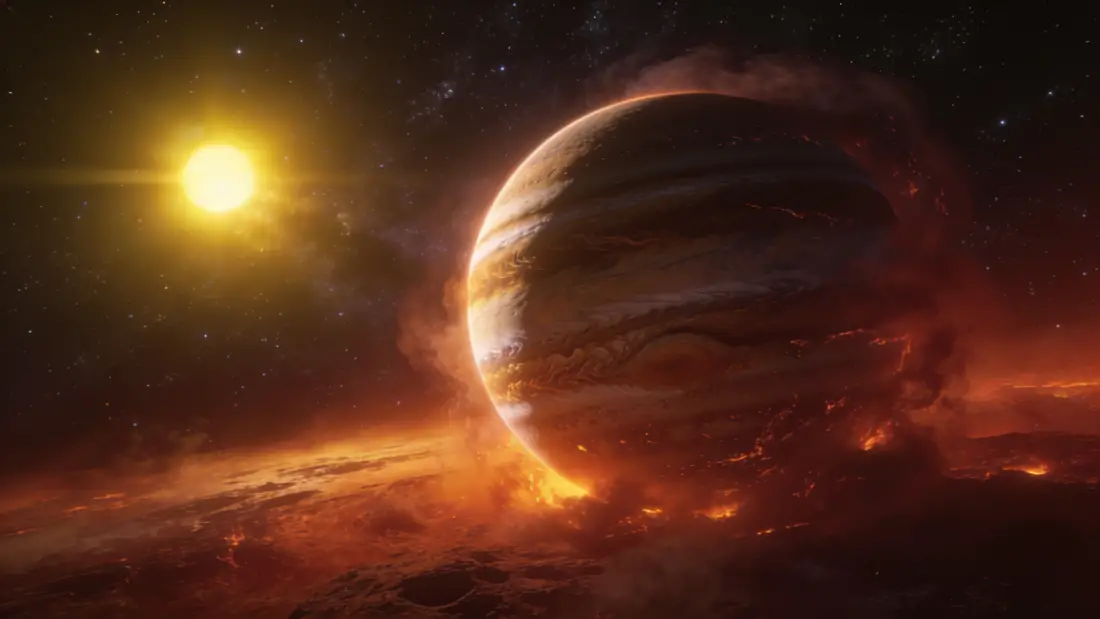
In 2026, astronomers confirmed a planet called TOI-5624 d orbiting a star about 332 light-years from Earth. It is one of five known worlds in that star system, and it raises some interesting questions about how planets form and what they are made of. Here is what we know so far.
Finding TOI-5624 d
TOI-5624 d was discovered using the transit method. That is when a planet passes in front of its star as seen from Earth, causing the star’s light to dim slightly — a little like a tiny shadow crossing a lamp. Telescopes watching for those dips in brightness can spot a planet even when it is too far away to see directly.
The name gives us useful clues. “TOI” stands for TESS Object of Interest. TESS is a space telescope designed to hunt for planets by watching stars closely over time. When TESS flags a star as interesting, scientists follow up with more observations to confirm whether a real planet is there. For TOI-5624 d, that confirmation came in 2026.
The letter at the end — “d” — tells us this is the fourth planet found in the system. Astronomers label planets in the order they are confirmed, starting with “b”. So planets b, c, d, e, and f have all been found around TOI-5624. You can explore other confirmed worlds from around the same era on the discovery timeline.
The Star TOI-5624
Every planet story starts with its star. TOI-5624 is the sun at the centre of this system, sitting 332 light-years away. A light-year is the distance light travels in one year — about 9.5 trillion kilometres. So TOI-5624 is very, very far away, even though it is still inside our own galaxy, the Milky Way.
The surface temperature of TOI-5624 is about 5,327 K. The K stands for Kelvin, a temperature scale scientists use that starts from absolute zero, the coldest anything can be. For comparison, our own Sun’s surface is around 5,778 K. That makes TOI-5624 a little cooler and slightly less bright than our Sun, though still a star of a broadly similar type. Stars like this are called G-type or K-type stars, depending on exactly how cool they run — TOI-5624 falls right near that boundary.
A slightly cooler star gives off a little less energy than our Sun does. That matters when scientists try to figure out how warm a planet around it might be.
Size, Mass, and What TOI-5624 d Might Be Made Of
TOI-5624 d is noticeably larger than Earth. Its radius — the distance from its centre to its surface — is about 3.58 times Earth’s radius. Its mass is roughly 4.9 times Earth’s mass. These two numbers together are very useful, because when scientists know both the size and the mass of a planet, they can estimate its density — how tightly packed its material is — and from that, make a guess about what it is made of.
A planet with a lot of mass squeezed into a small space is likely rocky, like Earth or Mars. A planet that is large but surprisingly light probably has a thick atmosphere or a layer of gas or water surrounding a smaller core. TOI-5624 d sits in an interesting middle range. Scientists sometimes call worlds like this sub-Neptunes — planets bigger than Earth but smaller than Neptune. They may have a rocky or watery interior wrapped in a deep, thick atmosphere, but we honestly are not sure yet. More observations would be needed to say with confidence.
You can compare TOI-5624 d with other worlds of similar size in the atlas.
A Scorching Short Year
One of the most striking things about TOI-5624 d is how quickly it orbits its star. One full orbit — what we would call a year — takes just 13.7 Earth days. That means this planet whips around TOI-5624 more than 26 times in the time it takes Earth to go around our Sun once.
Orbiting so close to its star comes with a cost: heat. The estimated surface temperature of TOI-5624 d is about 713 K, which is roughly 439 degrees Celsius. That is hot enough to melt lead. At that temperature, liquid water on the surface is almost certainly out of the question, and the planet sits well inside what scientists call the habitable zone — the range of distances from a star where liquid water could exist on a planet’s surface. TOI-5624 d is too close and too hot to be in that zone.
Five Worlds and Counting
TOI-5624 d does not travel alone. Its star hosts at least four other confirmed planets — making TOI-5624 a busy, multi-planet system. Finding several planets around one star is not unusual; our own Solar System has eight. But each multi-planet system we discover helps scientists understand patterns in how planets form and arrange themselves around different types of stars.
Having five planets confirmed in this system also gives researchers a chance to compare neighbours. Do the other planets have similar sizes? Different temperatures? Are any of them farther out and possibly cooler? Scientists haven’t published full details on all five worlds yet, so those comparisons are still being worked out.
What We Still Don’t Know
The confirmed data on TOI-5624 d gives us a solid starting point, but there is a lot left to learn. Scientists haven’t measured what its atmosphere is made of, if it has one at all. We don’t know its exact composition. And the details of the other four planets in the system are still being studied. That is completely normal for a newly confirmed world — discovery is always just the beginning. As telescopes become more powerful, we may learn far more about this distant, fast-moving planet and its neighbours.