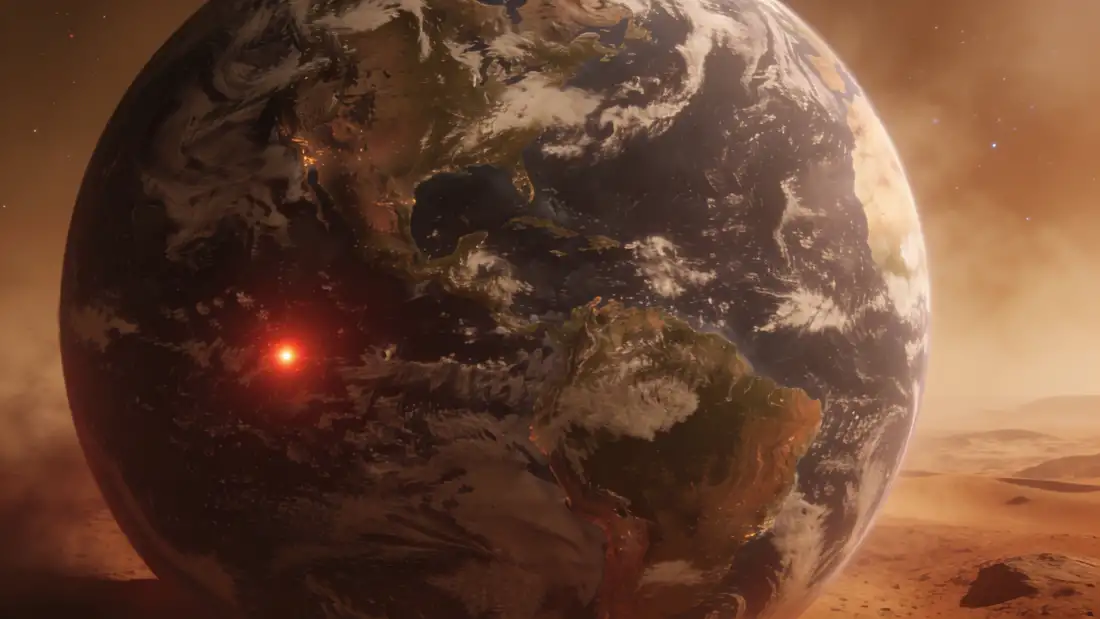
YZ Cet b is one of the closest known exoplanets — planets that orbit stars other than our Sun — to Earth. It sits just 12.1 light-years away, making its host star one of our nearest neighbors in the Milky Way. Even so, “nearby” in space still means a journey that is almost impossible to imagine.
How Far Away Is YZ Cet b?
The distance to YZ Cet b is 12.1 light-years. A light-year is the distance light travels in one full year. Light moves at about 300,000 kilometers every second, so a light-year is a very long way — roughly 9.5 trillion kilometers. Multiply that by 12.1 and you start to get a sense of the gap between us and this small world.
To help put that number in your hands: if you could line up 12.1 light-years, you would need to travel around Earth’s equator roughly 290 trillion times to match it. Numbers like that are hard to picture, and that is okay. The honest truth is that the universe is simply very large.
YZ Cet b was discovered in 2017. Scientists found it using the radial velocity method, which means they watched for tiny wobbles in the host star caused by the gravitational pull of orbiting planets. The wobble is so small it takes very careful instruments to detect it.
Putting 12.1 Light-Years into Perspective

Our closest stellar neighbor, Proxima Centauri, sits about 4.2 light-years away. That means YZ Cet is roughly three times farther than the very nearest star to our Sun. On a cosmic scale, though, 12.1 light-years is still extremely close. The Milky Way galaxy is about 100,000 light-years across. YZ Cet sits practically on our doorstep by that measure.
Think of it this way. If the entire Milky Way were shrunk down to the size of a continent, YZ Cet would be a small step away from where Earth stands on that continent. Both our Sun and YZ Cet would be tiny grains of sand almost touching each other, surrounded by an enormous stretch of galaxy in every direction.
Only a small number of known exoplanet systems are closer to us than 12.1 light-years. YZ Cet b sits in a rare and interesting part of our cosmic neighborhood. You can explore how it relates to other nearby systems on the Cosmic Map.
How Long Would It Take to Travel There?
No spacecraft built today could reach YZ Cet b in a human lifetime. Our fastest space probes travel at tens of thousands of kilometers per hour. At those speeds, crossing just one light-year would take tens of thousands of years. A trip to YZ Cet b at those speeds would take well over 100,000 years.
Even if we could somehow travel at one percent of the speed of light — far beyond anything we have ever built — the journey would still take more than 1,200 years. At ten percent of the speed of light, it would take about 121 years. And traveling at those speeds would require an amount of energy we have no way to produce today.
Scientists sometimes dream about what future propulsion — that means the system that pushes a spacecraft forward — might look like. But right now, all of that remains in the world of ideas. If you want to explore what different travel speeds would mean for reaching YZ Cet b, the Distance and Travel Time tool lets you try different speeds and see the result.
What Kind of Star Does YZ Cet b Orbit?
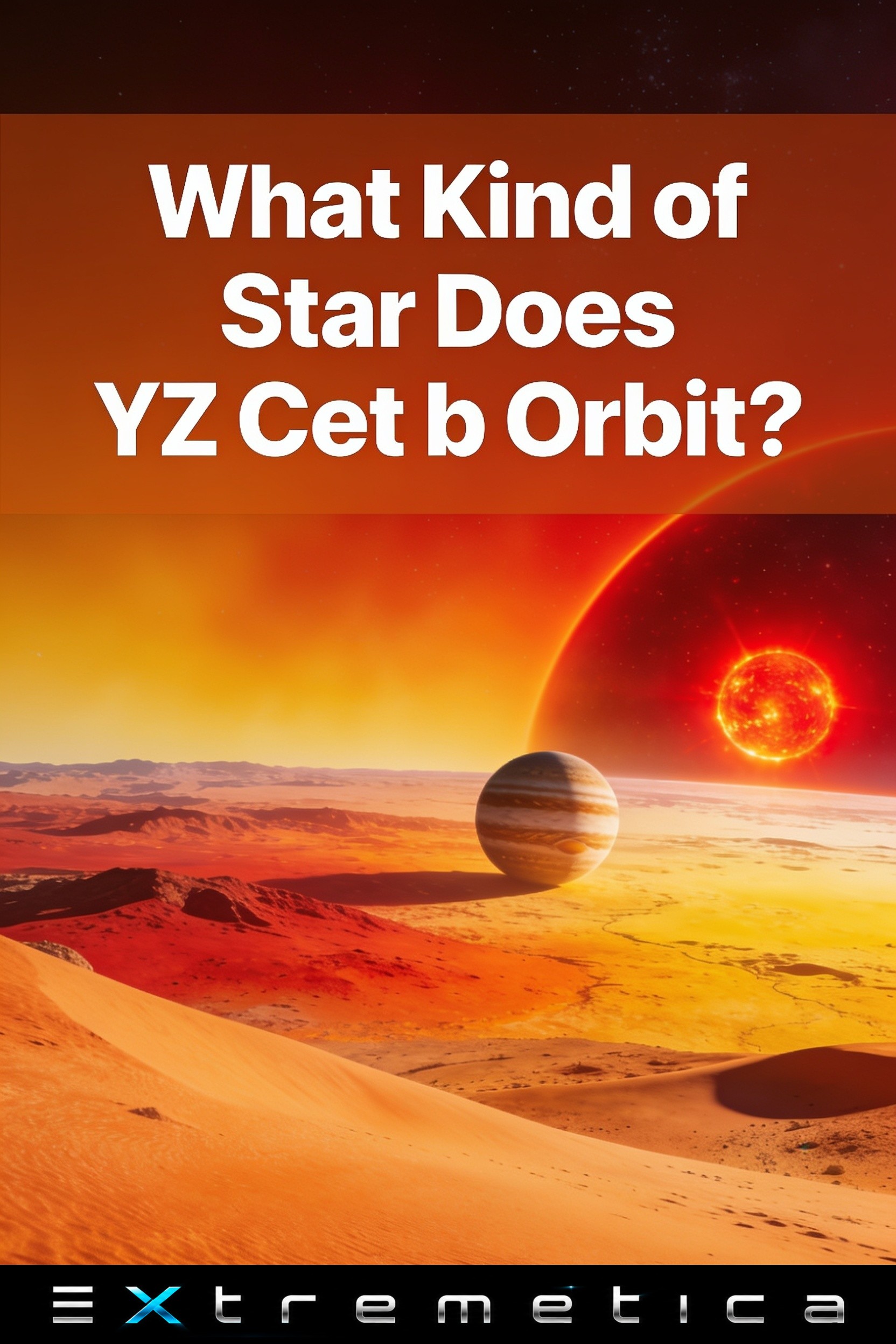
YZ Cet b orbits a star called YZ Cet. This star is a red dwarf, which is the name for a small, cool, dim type of star. Red dwarfs are the most common kind of star in the Milky Way, but they are all too faint to see with the naked eye from Earth, even when they are relatively nearby.
YZ Cet has a surface temperature of 3,151 Kelvin. To understand what that means, our own Sun’s surface sits at around 5,778 Kelvin. So YZ Cet is significantly cooler than the Sun. It also gives off much less light and energy overall. Red dwarfs like YZ Cet can live for hundreds of billions of years, far longer than stars like our Sun.
One thing astronomers watch closely with red dwarfs is their tendency to produce sudden bursts of energy called flares. These flares can be intense, and scientists are still working to understand what they might mean for any planets orbiting nearby.
The Planet Itself — Size, Mass, and Temperature
YZ Cet b is slightly smaller than Earth. Its radius — the distance from its center to its surface — is 0.91 times Earth’s radius. Its mass is 0.7 times Earth’s mass, meaning it is also lighter than our planet. In other words, this is a rocky-sized world, not a gas giant like Jupiter or Saturn.
Because YZ Cet b is smaller and less massive than Earth, scientists think it is likely a rocky planet, though we are not certain of its exact composition. The planet’s likely temperature is around 471 Kelvin, which works out to about 198 degrees Celsius. That is well above the boiling point of water. At that temperature, liquid water on the surface seems very unlikely, and the planet does not sit in what scientists call the habitable zone — the range of distances from a star where temperatures could allow liquid water to exist.
A Year That Lasts Two Days
One of the most striking things about YZ Cet b is how fast it orbits its star. One full orbit — what we would call a year on that planet — takes just 2.02 Earth days. That is less than a long weekend here on Earth.
This happens because YZ Cet b orbits very close to its star. The closer a planet is to its star, the faster it moves through its orbit. This is the same rule that applies to all planets, including those in our own solar system. Mercury, the closest planet to our Sun, has a year of about 88 Earth days. YZ Cet b moves even faster because it orbits a star that is much smaller and closer to its surface.
The system has three known planets in total. Scientists found all of them using the radial velocity method, and each one completes its orbit in just a few Earth days.
YZ Cet b in Our Cosmic Neighborhood
At 12.1 light-years away, YZ Cet b is one of the closer exoplanets we know about. It is far enough that no human technology today could reach it, yet close enough that astronomers can study its star and learn a great deal about the system. As telescopes improve, scientists hope to understand more about what this small, fast-moving world is really like. For now, YZ Cet b stands as a quiet reminder that even our nearest cosmic neighbors are still wonderfully out of reach.