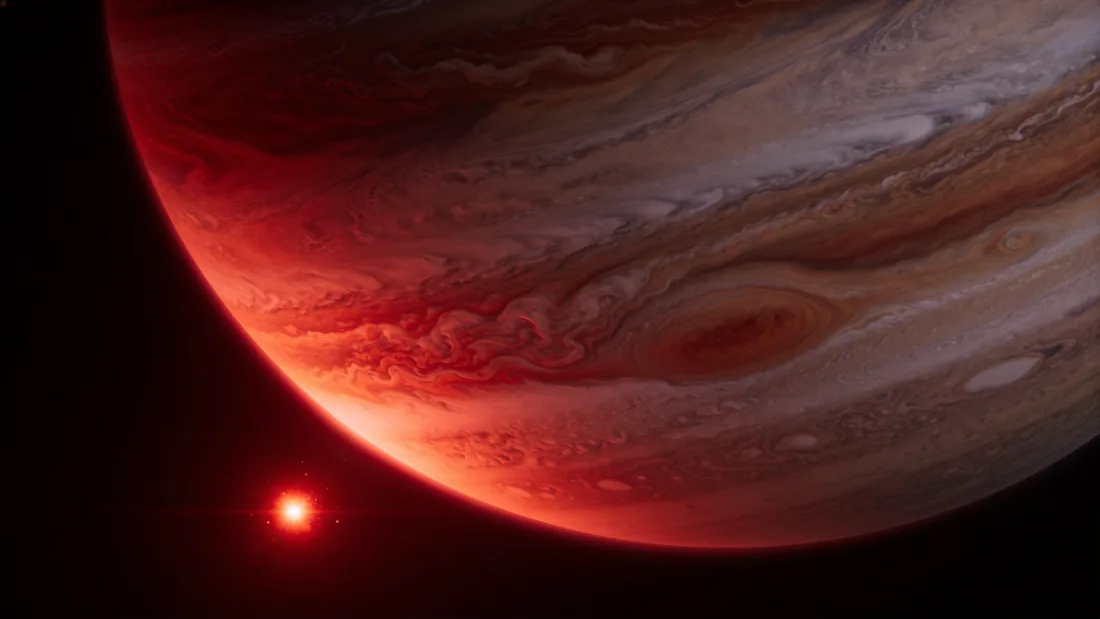
GJ 15 A c is one of our closer cosmic neighbors — a world orbiting a dim, cool star just 11.6 light-years from Earth. That sounds close by space standards, and in some ways it is. Yet the distance is still so enormous that it is very hard to picture. This article takes a careful look at what scientists know about this planet, how they found it, and what it means to live so far from something we can barely reach with radio waves.
Meet the Star: GJ 15 A
Before we look at the planet, it helps to understand where it lives. GJ 15 A c orbits a star called GJ 15 A. This star is a red dwarf — a type of star that is much smaller, cooler, and dimmer than our Sun. Red dwarfs are the most common type of star in our galaxy, the Milky Way, but they are so faint that you cannot usually see them with just your eyes on a clear night.
We know GJ 15 A’s surface temperature is 3,607 K. The letter K stands for Kelvin, a scale scientists use to measure temperature. For comparison, our Sun’s surface sits at around 5,778 K. So GJ 15 A is noticeably cooler. That lower temperature is why the star glows red-orange rather than the yellow-white of our Sun.
GJ 15 A is part of a wider group of stars that sit relatively close to us in space. Finding planets around nearby stars matters a great deal. The closer a star is, the easier it becomes — at least a little — for telescopes to study any worlds around it. You can explore how GJ 15 A fits into our local patch of space using the cosmic map.
What We Know About GJ 15 A c

GJ 15 A c is a sizable world. Scientists have measured its radius — that is, the distance from the center of the planet to its surface — at 6.67 times Earth’s radius. Its mass is 36.0 times the mass of Earth. That puts it in a class astronomers sometimes call a sub-Neptune or mini-Neptune — larger than Earth but smaller than the ice giant Neptune in our own solar system.
A planet of this size and mass is almost certainly not a rocky world like Earth. Scientists think it probably has a thick layer of gas, and possibly a deep, high-pressure mixture of water, ammonia, and other materials beneath that. We have nothing quite like it close to home. Earth, Venus, Mars, and Mercury are all rocky. Neptune and Uranus are much larger still. GJ 15 A c sits somewhere in between, in a size range our solar system simply does not offer for study.
It is worth being honest about what we do not know. Scientists haven’t measured what GJ 15 A c’s atmosphere is made of, or exactly what its surface — if it even has a solid surface — looks like. Most of what we say about its likely nature comes from comparing it to similar-sized planets we have studied elsewhere.
A Year That Lasts More Than 20 Earth Years

One orbit of GJ 15 A c around its star — one full year on this world — takes 7,600 Earth days. To put that in everyday terms: one year there is roughly 20.8 of our years. A child born on Earth would finish school, go to university, start a career, and still not have lived through a single year on GJ 15 A c.
Such a long year tells us something important. It means GJ 15 A c orbits quite far from its star. Even though GJ 15 A is a cooler, dimmer star than our Sun, a planet that takes 7,600 days to complete one trip around it must sit at a considerable distance. For comparison, our own planet takes just 365 days. Even Jupiter, the giant of our solar system, completes its orbit in about 4,333 days — still far less than 7,600.
This long orbit is one reason the planet was not easy to find. Detecting a planet with such a slow path around its star requires years and years of careful watching.
How Scientists Found This World
GJ 15 A c was discovered in 2018 using a technique called the radial velocity method. Here is how it works. As a planet orbits a star, its gravity gives the star a tiny tug. That tug makes the star wobble slightly — sometimes moving a little toward us, sometimes a little away. When the star moves toward us, its light shifts slightly to a bluer color. When it moves away, the light shifts slightly to a redder color. Scientists can measure these tiny shifts very precisely, and from them figure out that a planet must be pulling on the star.
The radial velocity method is especially good at measuring a planet’s mass, which is why we have a solid mass figure — 36.0 times Earth — for GJ 15 A c. The radius measurement comes from a different technique and carries its own set of careful estimates. Scientists are always working to refine these numbers as better instruments become available.
There are two known planets in the GJ 15 A system. GJ 15 A c was the second to be confirmed. Finding a second planet in a system often encourages astronomers to look more closely for others.
Just How Far Is 11.6 Light-Years?
A light-year is the distance light travels in one year. Light moves at about 300,000 kilometers every second — the fastest anything in the universe can travel. In one year, light covers roughly 9.46 trillion kilometers. At 11.6 light-years, GJ 15 A is about 110 trillion kilometers from Earth.
Our fastest spacecraft so far have traveled at speeds far, far below the speed of light. At those kinds of speeds, reaching GJ 15 A c would take many tens of thousands of years — longer than all of recorded human history. If you want to get a feel for just how long different journeys into space would take, the distance and travel time tool makes it easy to explore.
Still, 11.6 light-years is considered a near neighbor in cosmic terms. The Milky Way galaxy is roughly 100,000 light-years across. On that scale, GJ 15 A is practically in our backyard.
Could Anything Live There?
The habitable zone is the range of distances from a star where temperatures could, in theory, allow liquid water to exist on a planet’s surface. Liquid water is important because, as far as scientists know, all life needs it. GJ 15 A c’s very long orbit suggests it sits far from its star. Whether that places it inside, outside, or on the edge of GJ 15 A’s habitable zone is something scientists haven’t pinned down clearly yet.
Even if it were in the right zone, a world 36 times Earth’s mass with a likely thick gas envelope would be very different from the kinds of places where we know life thrives. Scientists think conditions there would be quite extreme by Earth standards. No evidence of life has been found, and we have no way to check up close — not yet.
GJ 15 A c reminds us how much variety exists even among our nearest stellar neighbors. It is a large, slow-orbiting world around a quiet red star, close enough that future telescopes might one day study it in more detail, yet so far away that it remains, for now, a set of carefully measured numbers and a great deal of open questions.