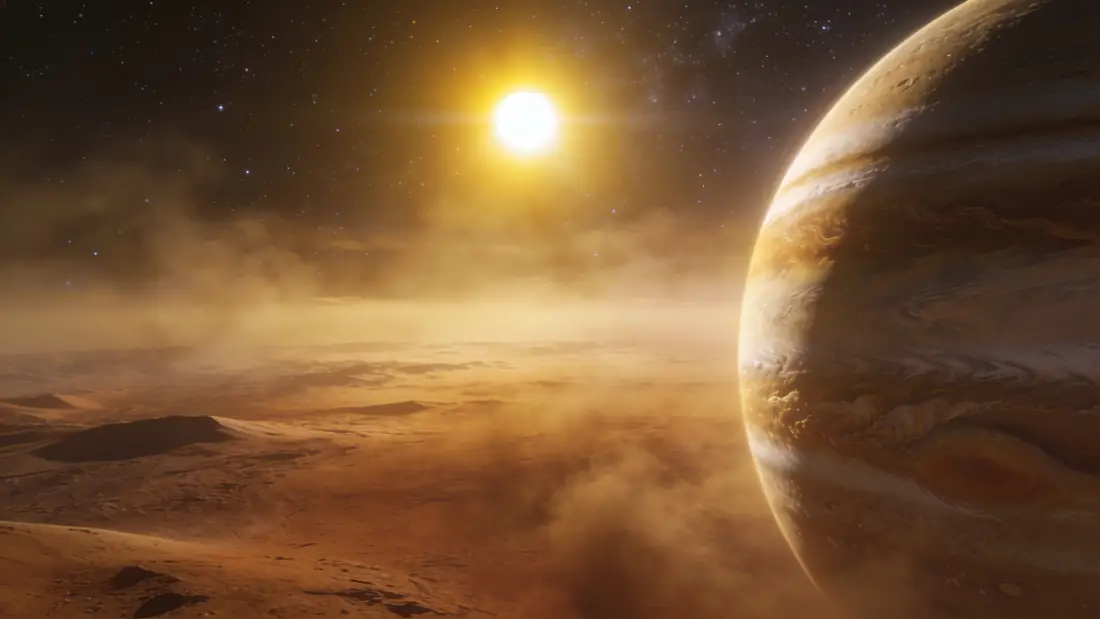
TOI-5624 f is a world roughly three and a half times wider than Earth, orbiting a star that looks a lot like our own Sun. It sits in a system full of company, and scientists only confirmed it in 2026. There is a lot to explore here, even from 332 light-years away.
A Busy Star System, 332 Light-Years Away
The star TOI-5624 is a sun-like star, meaning it is similar in many ways to our own Sun. Its surface temperature is 5,327 K (measured in Kelvin, a scale scientists use for very high temperatures — 5,327 K is roughly 4,800 degrees Celsius). Our Sun’s surface sits around 5,778 K, so TOI-5624 is a little cooler, but they are the same broad type of star.
Light from TOI-5624 takes 332 years to reach us. That is a long journey, but in the scale of our galaxy, it is a fairly close neighbor. The system holds at least five known planets, making it one of the more crowded planetary systems we have found so far.
What “Mini-Neptune” Actually Means
Planets come in a few broad categories based on their size and what they are made of. Earth is a rocky world — solid ground, thin atmosphere. Neptune, the outermost planet in our solar system, is much larger and wrapped in thick layers of gas and ice. A mini-Neptune is a planet that falls between those two ideas: bigger than Earth, but smaller than Neptune, and likely covered in a thick blanket of gas or a deep layer of water and ice under a heavy atmosphere.
Scientists think most mini-Neptunes do not have a hard rocky surface you could stand on. Deep inside, there might be a rocky or icy core. But above that, the pressure and temperature climb so high that the boundary between gas and liquid blurs. It would be a strange place by any measure we are used to.
Mini-Neptunes are actually one of the most common types of planet we find around other stars. That is interesting, because our own solar system has nothing quite like them — we jumped straight from rocky planets like Earth and Mars to the much larger gas giants, with nothing in between. Finding so many mini-Neptunes elsewhere tells us our solar system might be a little unusual.
Size, Mass, and What They Tell Us

TOI-5624 f has a radius of 3.66 times Earth’s. That means if you lined up Earths side by side across the middle of this planet, you would need almost four of them to cross it. Its mass is 13.0 times Earth’s — so it contains about thirteen times as much material as our planet.
When scientists have both a radius and a mass, they can calculate density — how tightly packed the material inside a planet is. Density is a powerful clue. A small but very heavy planet is probably rocky, like Earth or Mars. A large but surprisingly light planet is probably made mostly of gas or water. TOI-5624 f is not especially heavy for its size. That points toward a world with a thick atmosphere, a lot of water or ice, or some combination of the two — rather than a mostly rocky interior.
Scientists use something called a mass-radius diagram to compare these measurements across hundreds of known planets at once. On that diagram, TOI-5624 f lands in a region that is consistent with a water-rich world or a rocky planet wrapped in a very thick gas envelope. We do not know for certain which — figuring that out would likely take more observations.
Its estimated temperature is about 479 K, which is roughly 205 degrees Celsius. That is hotter than boiling water. This temperature is an estimate of how much heat the planet receives from its star, not a direct measurement from the surface. Scientists haven’t measured the planet’s actual surface or atmospheric temperature yet, so we hold this number carefully.
A Year That Lasts 45 Days

TOI-5624 f completes one full orbit around its star every 45.4 Earth days. That is its year — a little over six weeks. By comparison, Earth takes 365 days to go once around the Sun.
A short year usually means a planet is orbiting fairly close to its star. Being closer means receiving more heat, which matches the estimated temperature. At 205 degrees Celsius, TOI-5624 f is far too hot for liquid water as we know it — placing it outside the habitable zone, the band of distances around a star where temperatures might allow liquid water to exist on a rocky surface. Scientists think liquid water is important for life, so a planet this warm is not considered a strong candidate for life as we know it.
Still, its orbit is useful for studying the system as a whole. Knowing where all five planets orbit helps scientists understand how the system formed and how the planets influence each other over time.
How Scientists Found TOI-5624 f
TOI-5624 f was discovered in 2026 using a technique called Transit Timing Variations, often shortened to TTV. To understand TTV, it helps to know about the transit method first. When a planet passes in front of its star as seen from Earth, it blocks a tiny bit of starlight. Telescopes can detect that dip. If transits happen on a perfectly regular schedule, the planet is orbiting alone. But if the timing shifts slightly — a transit arriving a little early or a little late — something else is tugging on that planet with gravity. That something else is often another planet.
TTV is powerful because it can reveal planets that might not transit the star themselves. Scientists watch for the wobbles in timing, then work backward to find what is causing them. This is how TOI-5624 f was confirmed — by the gravitational fingerprint it leaves on its neighbors.
Five Worlds Around One Star
TOI-5624 f is one of five known planets in this system. Multi-planet systems like this one are fascinating because each world interacts with the others through gravity. Those interactions shape orbits over millions of years. They can also help scientists measure planet masses — as one planet tugs on another, the strength of the tug reveals how much mass each one has. That is part of why TTV worked here.
We do not yet have detailed information about all five planets. Scientists haven’t measured the sizes, masses, or temperatures of every world in the system. As tools improve, more details will likely come into focus. You can explore how TOI-5624 f stacks up against other known worlds using the size comparison tool on this site.
TOI-5624 f is a useful example of how much we can learn from a planet we will never visit. Radius, mass, timing, temperature — each measurement adds a piece to the picture, even across 332 light-years of space.