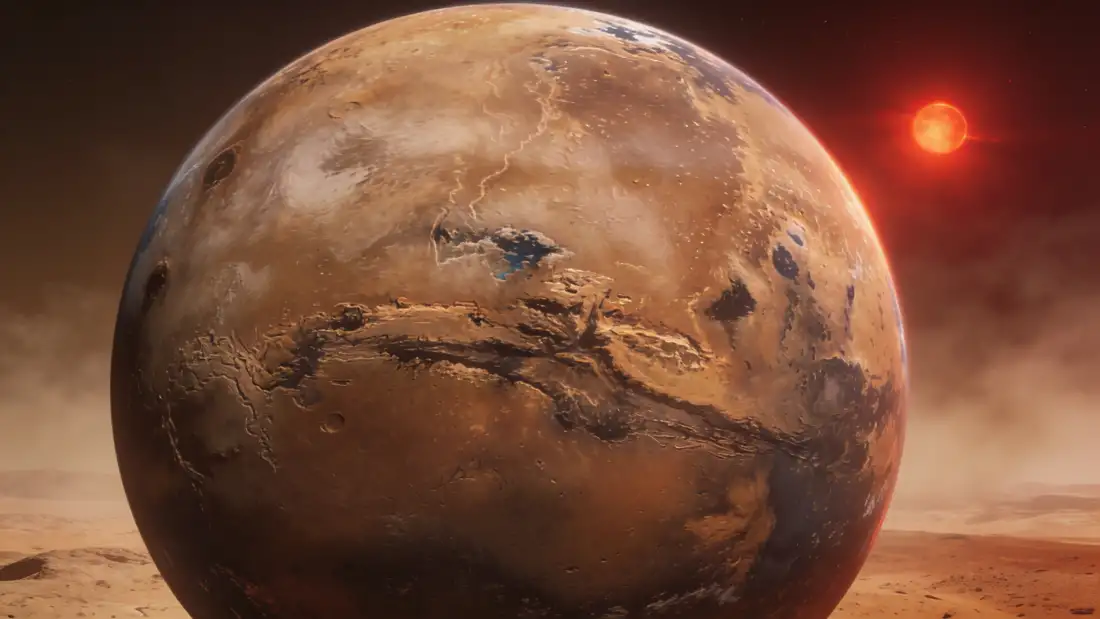
YZ Cet d is one of our closer cosmic neighbors — a small planet circling a dim star just 12.1 light-years from Earth. That sounds almost within reach, until you start to understand what 12.1 light-years actually means.
The Star Called YZ Cet
YZ Cet d orbits a star named YZ Cet. This star sits in the constellation Cetus, which is the whale-shaped pattern of stars you can find in the night sky.
YZ Cet is a red dwarf. That means it is a small, cool, dim kind of star — much smaller and fainter than our own Sun. Its surface temperature is 3,151 K (K stands for kelvin, a way scientists measure heat; room temperature is roughly 294 K). For comparison, our Sun’s surface is around 5,778 K. So YZ Cet burns much cooler and redder than the Sun.
Red dwarfs are actually the most common type of star in the Milky Way — our galaxy. Because they are so plentiful, astronomers study them closely. Many red dwarfs turn out to have planets, which makes them interesting places to look.
Just How Far Is 12.1 Light-Years?
A light-year is the distance light travels in one year. Light moves at about 300,000 kilometers every single second — the fastest speed anything in the universe can travel. In one year, light covers about 9.46 trillion kilometers.
YZ Cet is 12.1 light-years away. That means the light reaching your eyes from that star tonight left it 12.1 years ago. You are looking into the past every time you glance at the night sky.
Twelve light-years might sound modest on a cosmic scale, and in some ways it is. The Milky Way galaxy stretches about 100,000 light-years across. Compared to that, YZ Cet is right on our doorstep. In fact, it is one of the closest known planetary systems to Earth. You can explore where it sits among other nearby stars using the cosmic map.
But “close” in space is still an enormous distance by everyday standards. If you could drive a car at highway speed without stopping, it would take you far longer than the age of our solar system to get there. The gap between stars is simply vast.
A Trip to YZ Cet d at Real Speeds

Humans have sent spacecraft far into space. The fastest human-made object ever launched, Voyager 1, travels at roughly 17 kilometers per second. That sounds fast. At that speed, you could circle Earth in less than half an hour.
But at Voyager 1’s speed, a trip to YZ Cet would take well over 200,000 years. That is longer than modern humans have existed on Earth. No one would survive the journey, and no spacecraft built today could come close to making it.
Scientists sometimes imagine future ships traveling at a small fraction of the speed of light. Even at one percent of light speed — far beyond anything we can build — the trip would still take more than a thousand years. The distance is real, and it is humbling.
If you want to play with these numbers yourself, the distance and travel time tool lets you see how long the journey would take at different speeds.
YZ Cet d Up Close
So what would you find if you somehow arrived at YZ Cet d? Scientists have measured some things about this world, though many details are still unknown.
YZ Cet d is remarkably close to Earth in size and mass. Its radius is 1.03 times Earth’s radius, and its mass is 1.09 times Earth’s mass. Those numbers are so close to Earth’s that this planet is sometimes called Earth-sized. That is unusual — most exoplanets (planets outside our solar system) that we have found are much larger.
The estimated surface temperature for YZ Cet d is 357 K, which is about 84 degrees Celsius (roughly 183 degrees Fahrenheit). That is hotter than the boiling point of water at a high mountain, and far hotter than a comfortable summer day. Scientists think the planet sits too close to its star to be in the habitable zone — the range of distances where liquid water could exist on a surface. As far as we know, YZ Cet d is likely too warm for that. However, scientists haven’t measured an atmosphere for this planet, and without knowing more about it, we can’t say for certain what conditions are really like there.
A Year in Four and a Half Days

One of the strangest things about YZ Cet d is how quickly it orbits its star. One full orbit — its “year” — takes just 4.66 Earth days. That means if you lived there, your birthday would come around roughly every five days.
This short year happens because YZ Cet d orbits very close to its star. The closer a planet orbits, the faster it must travel to stay in orbit. Because YZ Cet is a cool, dim star, being very close to it does not necessarily mean being scorched — but in YZ Cet d’s case, the estimated temperature still comes out quite high.
Scientists haven’t measured how long a day lasts on YZ Cet d, or whether it spins freely or is tidally locked — where one side of the planet always faces the star, the way our Moon always shows us the same face. Tidal locking is common among planets that orbit so close to their stars, but for this planet, we simply don’t know yet.
How Scientists Found It
YZ Cet d was discovered in 2017 using a technique called the radial velocity method. Here is how it works. As a planet orbits a star, its gravity gives the star a tiny tug. That tug causes the star to wobble slightly — moving toward us, then away from us, in a repeating pattern. Scientists can detect that wobble by watching how the star’s light shifts. When light from something moving toward you is slightly “squished” to shorter wavelengths, and light from something moving away is “stretched” to longer ones, that shift can be measured very precisely.
By studying the size and timing of YZ Cet’s wobble, scientists worked out that three planets were pulling at it — including YZ Cet d.
Three Worlds Around One Small Star
YZ Cet d is not alone. Its system contains three known planets altogether. Scientists haven’t published details here about the other two — their sizes, masses, and temperatures are not part of what we know for this article. What we do know is that having multiple planets around a red dwarf is not unusual. Many of these small stars seem to host compact groups of planets, all orbiting closer to their star than Mercury orbits our Sun.
Studying systems like this one helps scientists understand how common planets are across the universe — and what kinds of worlds exist out there among the stars. YZ Cet d, small and surprisingly Earth-sized, quietly orbits its dim red star just 12.1 light-years away, reminding us that even our nearest neighbors are separated from us by distances that are almost too large to imagine.