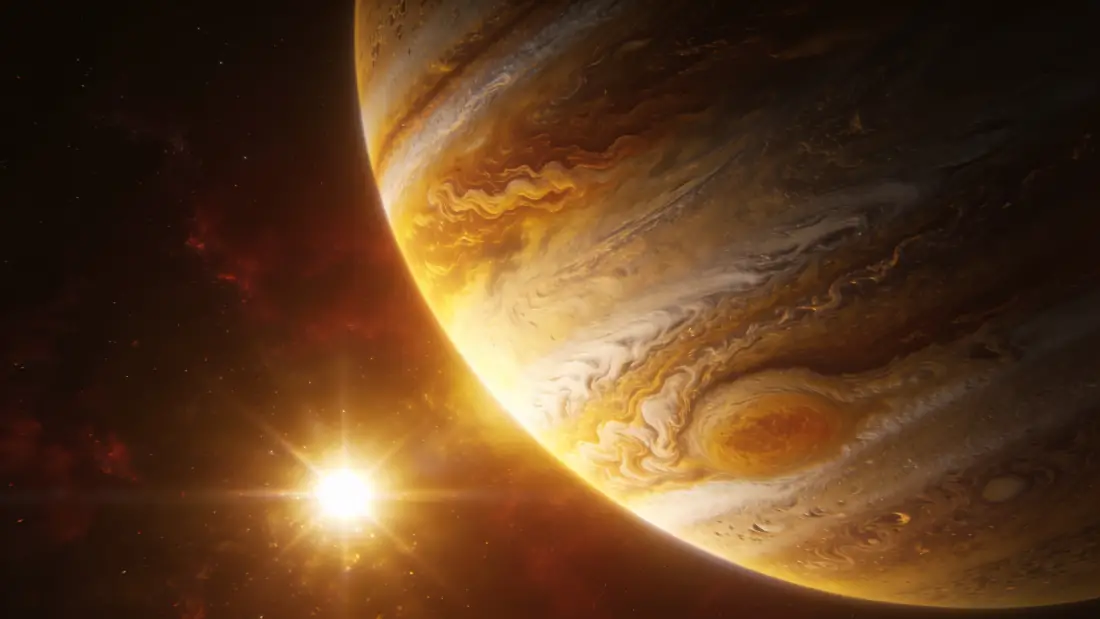
In 2026, astronomers confirmed a new planet called TOI-883 b — a large, hot world orbiting a star 335 light-years from Earth. It sits in a growing list of planets that remind us just how varied the universe can be. This one has a lot to tell us, even from so far away.
Where in the Sky Is TOI-883 b?
TOI-883 b orbits a star called TOI-883. That star sits about 335 light-years away from us. A light-year is the distance light travels in one year — roughly 9.5 trillion kilometers. So 335 light-years is an enormous distance, far beyond anything a spacecraft could reach in a human lifetime with today’s technology.
The star TOI-883 has a surface temperature of 5,713 K. For comparison, our own Sun has a surface temperature of about 5,778 K. That makes TOI-883 very similar to the Sun — just a touch cooler. It is what astronomers call a solar-type star, meaning it belongs to roughly the same family as our own star.
So far, TOI-883 b is the only planet scientists have confirmed in this system. There may be others waiting to be found, but as of now, this world orbits alone in what we know of its solar system. You can explore other confirmed worlds in our atlas of known exoplanets.
What Kind of Planet Is This?
TOI-883 b has a radius — that is, the distance from its center to its surface — of about 7.17 times Earth’s radius. Its mass is about 40.7 times Earth’s mass. These two numbers together tell scientists a great deal about what kind of world it probably is.
A planet this size and mass is not rocky like Earth or Mars. It falls into a category often compared to Neptune, one of the outer planets in our own solar system. Neptune-like planets tend to have thick layers of gas and ice surrounding a denser core. Scientists think TOI-883 b is probably built in a similar way, though they cannot see inside it directly.
When astronomers talk about a planet’s density — how much matter is packed into a given space — the combination of size and mass for TOI-883 b points toward a world that is less dense than a rocky planet would be. That fits the Neptune-like picture well. Still, scientists are careful. Figuring out exactly what a distant planet is made of takes more study and more data.
A Very Fast Year
One of the most striking things about TOI-883 b is how quickly it travels around its star. One full orbit — what we would call a year on that planet — takes just 10.1 Earth days. To put that in perspective, Mercury, the closest planet to our Sun, takes about 88 Earth days to complete one orbit. TOI-883 b moves much faster than even that.
A planet moves that quickly only when it orbits very close to its star. TOI-883 b is almost certainly hugging its host star at a very short distance. Scientists haven’t published the exact orbital distance in the data we have, but the short year length tells us clearly that this world is much, much closer to its star than Earth is to the Sun.
Hot, But Why?

The estimated temperature of TOI-883 b is about 861 K, which is roughly 588 degrees Celsius. That is well above the melting point of many metals. It is far too hot for liquid water, and far too hot for life as we know it.
This high temperature comes directly from being so close to its star. A planet that completes an orbit in just over 10 days is receiving an intense amount of energy from its host star, every single day. The star itself is similar in temperature to our Sun, so it pours out a similar amount of heat and light. A planet sitting so close to that heat source gets baked.
It is worth noting that 861 K is what scientists call an equilibrium temperature — an estimate of how hot the planet’s outer layers might be based on how much starlight it receives. The true temperature at any given spot could be different, depending on things like clouds, winds, or how the planet reflects light. Scientists use this number as a useful starting point, not a final answer.
How Scientists Found It
TOI-883 b was discovered using the transit method. This technique works by watching a star very carefully over time. When a planet passes in front of its star — from our point of view — it blocks a tiny fraction of the star’s light. That tiny dip in brightness tells astronomers a planet is there. By measuring how much light dims, and for how long, scientists can work out a planet’s size and orbit.
Because TOI-883 b orbits so quickly, it passes in front of its star very often. That gives scientists many chances to observe and confirm the signal. The discovery was confirmed in 2026. You can see how this fits into the broader story of planet hunting on our discovery timeline.
What We Still Don’t Know
There is still plenty to learn about TOI-883 b. Scientists haven’t yet measured things like the exact composition of its atmosphere, whether it has moons, or what its surface — if it even has one — might look like. These are hard questions to answer from 335 light-years away, and they will likely require future telescopes and long observation campaigns.
TOI-883 b joins a large and growing family of Neptune-like worlds that orbit close to their stars. Each one we find adds a small piece to a much larger puzzle — the question of how planetary systems form, evolve, and end up looking so different from our own. This particular piece is well worth knowing about.