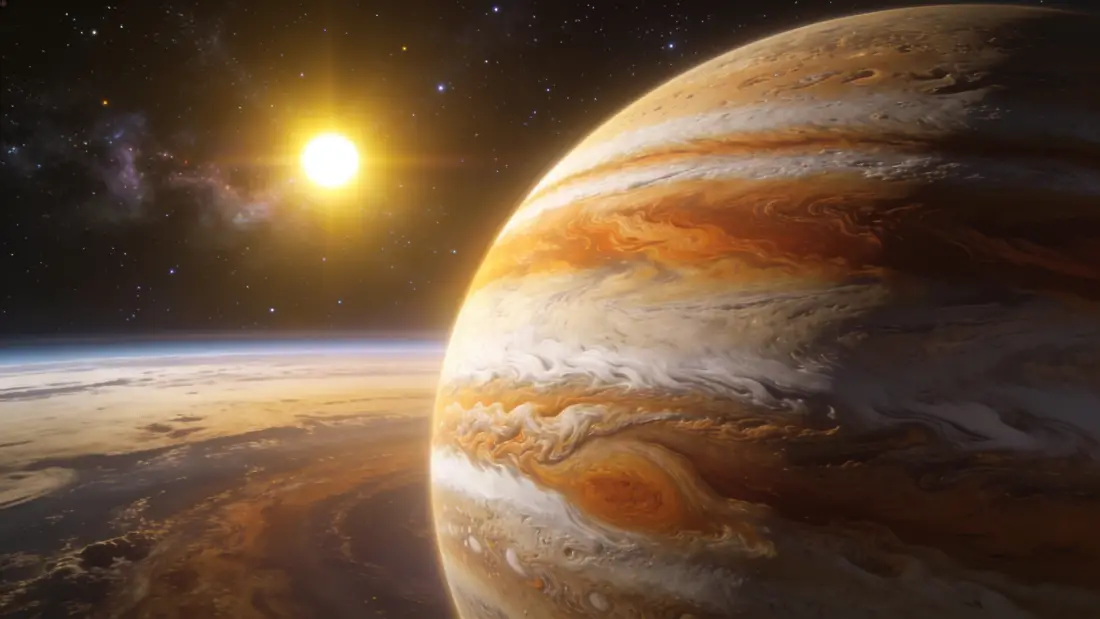
In 2026, astronomers announced a new world orbiting a distant star called DMPP-7. They named it DMPP-7 b. To find it, they never took a photo of it. Instead, they listened to the way the planet tugged on its star — a clever trick astronomers call the wobble method.
A Planet 331 Light-Years Away
DMPP-7 is the star at the heart of this story. It sits about 331 light-years from Earth. A light-year is the distance light travels in one year — about 9.5 trillion kilometres. So 331 light-years is an almost unimaginably large gap between us and that star.
The star DMPP-7 has a surface temperature of 5,997 K. The K stands for Kelvin, a scale scientists use to measure heat. Our own Sun’s surface sits at around 5,778 K, which makes DMPP-7 slightly warmer than the Sun. That places it in a similar family — a yellow-white star, reasonably calm and steady.
Orbiting that star is DMPP-7 b. One year on this planet — the time it takes to complete one full trip around its star — lasts just 4.98 Earth days. That is less than five days for an entire year. The planet is flying around its star at great speed, tucked in very close.
Why Finding Exoplanets Is So Hard
An exoplanet is a planet that orbits a star other than our Sun. Finding one sounds exciting, but it is genuinely difficult. Stars are far brighter than any planet beside them. Trying to spot a planet next to its star is a little like trying to see a firefly hovering next to a lighthouse, from many kilometres away.
Because of this, astronomers almost never take direct photographs of exoplanets. Instead, they look for the effects a planet has on its star. Two of the most useful methods are the transit method and the radial velocity method — also called the wobble method.
The transit method watches for a tiny dimming of starlight when a planet crosses in front of its star, like a small shadow. The wobble method works differently. It listens for motion. You can explore how both methods work with an interactive simulator if you want to see them in action.
How the Wobble Method Works — Step by Step
Most people picture a planet orbiting a star the way a ball on a string swings around your hand. But that is not quite right. Both the planet and the star are pulling on each other with gravity. While the planet orbits the star, the star also wobbles slightly, pulled by the planet’s gravity.
This wobble is tiny. For a small planet, it might shift the star only a few metres per second — about jogging pace. But scientists can measure it using a tool called a spectrograph. A spectrograph splits starlight into a rainbow of colours, like a prism. Each chemical element in the star leaves a specific pattern of dark lines in that rainbow.
Here is the clever part. When the star wobbles toward us, those lines shift very slightly toward the blue end of the rainbow. When the star wobbles away, the lines shift toward the red end. This shift is called the Doppler effect — the same reason a siren sounds higher-pitched as an ambulance comes toward you and lower-pitched as it drives away.
By measuring how much those spectral lines — the dark lines in the rainbow of starlight — shift back and forth, and how often the shift repeats, astronomers can work out how massive the planet is and how long its orbit takes. The bigger the planet, the bigger the wobble, and the easier it is to detect.
What the Wobble Tells Us About DMPP-7 b
The radial velocity measurements of DMPP-7 gave scientists two key numbers for DMPP-7 b. First, its mass — a measure of how much material the planet contains. DMPP-7 b has a mass of 61.4 times the mass of Earth. That is very large compared to our own world. Second, its orbital period — the length of its year — came out at 4.98 Earth days.
Scientists also measured its radius, which is 9.13 times the radius of Earth. Radius is the distance from the centre of a planet to its surface. A larger radius means a puffier, bigger world overall.
Now, knowing both the mass and the radius of a planet lets scientists calculate its density — how tightly packed the material inside it is. A planet that is very massive but also very large might be made mostly of gas, like Jupiter. One that is massive but small might be rocky and dense. The numbers for DMPP-7 b suggest it is likely a gas-rich world, though scientists are still working out its exact composition — what it is actually made of.
One thing the wobble method cannot easily tell us is what the planet’s atmosphere is like, or whether liquid water could exist there. DMPP-7 b orbits so close to its star, completing a full orbit in under five days, that it is almost certainly extremely hot. Scientists haven’t yet measured its temperature directly, but a world that close to a star like DMPP-7 would receive an enormous amount of radiation.
Comparing DMPP-7 b to Worlds We Know
At 9.13 times Earth’s radius and 61.4 times Earth’s mass, DMPP-7 b falls into a category sometimes called a sub-Saturn or a large Neptune-like planet. It is smaller than Saturn — which is roughly nine times Earth’s radius — but much, much bigger than Earth. Think of it as sitting in a middle range: not a small rocky world, not a full gas giant, but something in between.
Its very short orbit is a feature astronomers find interesting. Planets that orbit this close to their star are sometimes called hot Neptunes or hot sub-Saturns, depending on their size. They are harder to find around some types of stars, so each new one discovered helps scientists understand how planets form and migrate — meaning how they move inward from where they first form.
One Planet So Far — What Comes Next
As of its discovery in 2026, DMPP-7 b is the only known planet in the DMPP-7 system. That does not mean it is alone — it simply means no other planets have been confirmed yet. Finding a second, smaller planet would require more observations and time.
Astronomers will likely continue watching DMPP-7 to see if any other wobble patterns appear. Each new measurement adds to the picture. DMPP-7 b is a good reminder that the wobble method, patient and precise, keeps turning up new worlds — one careful signal at a time.