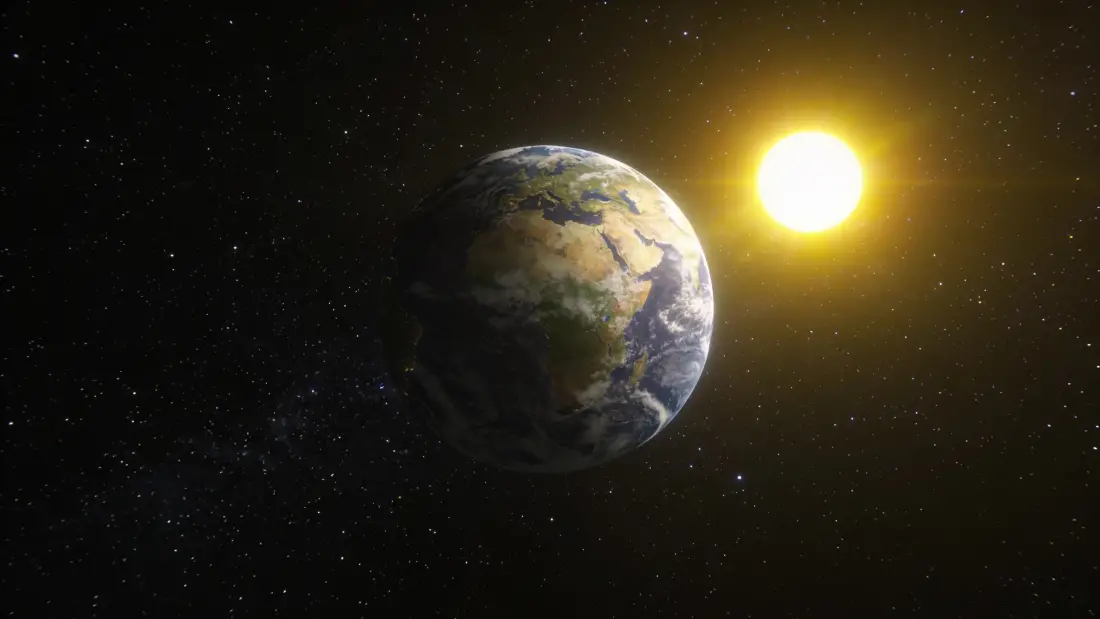
About 87.4 light-years from Earth, a star called HD 134606 holds a small family of worlds in its gravity. In 2024, scientists confirmed that this family has five members. One of the newest to be named is HD 134606 e, a planet that has already told researchers some interesting things about how planetary systems can form and arrange themselves.
The Star at the Center
HD 134606 is the sun of this system. It is a star, which means it produces its own light and heat through nuclear reactions deep in its core. Its surface temperature has been measured at 5,576 Kelvin. Kelvin is a temperature scale scientists use — 5,576 K is roughly similar to, though a little cooler than, our own Sun, which sits near 5,778 K. That makes HD 134606 what astronomers call a G-type star, in the same broad family as the Sun.
Because the star is fairly Sun-like, it produces a steady, calm kind of starlight. That is worth noting when thinking about the planets around it. A calmer star is generally less likely to blast its planets with huge bursts of radiation. Whether that matters for life around HD 134606 is a question scientists haven’t answered yet.
The star sits 87.4 light-years away. A light-year is the distance light travels in one full year — about 9.5 trillion kilometres. At that distance, HD 134606 is too faint to see with the naked eye on a clear night, but it is well within range of modern telescopes.
Meet HD 134606 e
HD 134606 e is one of five known planets in this system, and it was confirmed in 2024. Scientists found it using a technique called the radial velocity method — more on that shortly. What the data shows is a world that is noticeably larger and more massive than Earth, but still much smaller than a planet like Neptune.
Its radius — the distance from its center to its surface — is about 1.33 times Earth’s radius. Its mass is about 2.34 times Earth’s mass. A planet in this size and mass range is sometimes called a super-Earth. That term just means a rocky or rocky-gassy planet that is bigger than Earth but smaller than the ice giants in our Solar System. Scientists aren’t yet sure whether HD 134606 e is mostly rock, mostly gas, or some mixture of both. That kind of detail is hard to pin down from this distance.
One of the most striking things about HD 134606 e is how fast it travels around its star. One full orbit — its year — takes only 4.32 Earth days. For comparison, Earth takes 365 days to go around the Sun. A year on HD 134606 e is incredibly short because the planet sits very close to its star. That closeness almost certainly means the planet is very hot. Scientists haven’t published a confirmed surface temperature for it yet, but a world that close to even a calm star would receive a great deal of energy.
Because it orbits so close to HD 134606, the planet almost certainly sits well inside what scientists call the habitable zone — the band of distances around a star where liquid water could exist on a planet’s surface. HD 134606 e is probably far too hot for liquid water, though scientists haven’t measured its conditions directly.
A Family of Five
HD 134606 e is just one member of a five-planet system. Planetary systems — groups of planets sharing one star — come in many different shapes and sizes. Some stars have only one known planet. Others, like HD 134606, have several. Five known planets around one star puts HD 134606 in good company; our own Solar System has eight.
Scientists haven’t published detailed confirmed data for all five planets in the HD 134606 system in the same way they have for HD 134606 e, so it would not be accurate to list specifics for the others here. What researchers do know is that the system contains multiple planets arranged around the star, and that studying how they relate to one another helps scientists understand how planets form. You can explore what’s known about the full arrangement using our system explorer.
Multi-planet systems are valuable to study because the planets can affect each other through gravity. The pull of one planet can slightly shift the orbit of another. Mapping those interactions over time helps scientists learn about the history of a system — how it was born, and how it has changed.
How Scientists Found These Planets
HD 134606 e and its neighbours were found using the radial velocity method. Here is how it works. When a planet orbits a star, it doesn’t just circle passively. Its gravity gives the star a small tug. That tug makes the star wobble very slightly — toward us, then away, then toward us again. When the star wobbles toward Earth, the light it sends us gets compressed slightly, shifting toward the blue end of the colour spectrum. When it wobbles away, the light stretches toward the red end. Scientists measure these tiny colour shifts very carefully. The pattern of the shifts reveals the planet’s presence, its mass, and how long its orbit takes.
The radial velocity method is especially good at finding planets that are fairly massive and orbit close to their stars, because those planets create the biggest wobbles. That is part of why HD 134606 e, with its short 4.32-day orbit, was detectable.
How This System Compares to Ours
Our Solar System has all of its rocky planets — Mercury, Venus, Earth, and Mars — spread out over a range of distances from the Sun. Even Mercury, the closest, takes 88 days to complete one orbit. HD 134606 e, by contrast, finishes an orbit in just over four days. This suggests it sits much, much closer to its star than any planet in our Solar System sits to the Sun.
This kind of tight, fast-orbiting planet is common in the exoplanet systems scientists have found so far. It doesn’t mean all planetary systems look like this — it partly reflects what the radial velocity method is best at detecting. Planets farther out, orbiting slowly, create smaller and slower wobbles that are harder to spot. So our picture of systems like HD 134606 may still be incomplete.
What We Still Don’t Know
Honest science always comes with open questions, and HD 134606 is no different. Scientists haven’t yet confirmed the surface temperatures, compositions, or atmospheres of the planets here. They haven’t measured whether any planet in the system sits in the habitable zone or holds conditions that could support life. The 2024 discovery of HD 134606 e is recent, and researchers will need more time and more data to fill in those gaps.
What is already clear is that HD 134606 is a rich and interesting system. A Sun-like star, five known planets, and at least one confirmed super-Earth make it a useful place for scientists to study how worlds arrange themselves around a star. As telescopes improve and more observations are made, this quiet corner of the sky 87.4 light-years away may have quite a bit more to teach us.