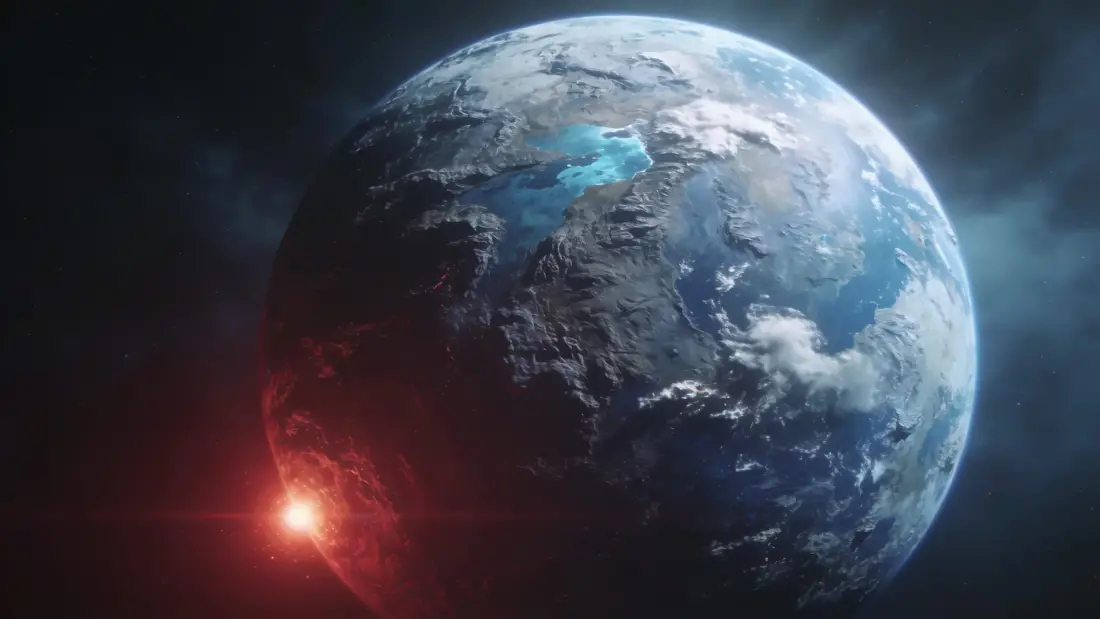
Four hundred light-years away, a planet called K2-332 b travels around a small, cool star. Scientists spotted it in 2021, and it has drawn a lot of attention since then. One reason stands out: its estimated temperature puts it close to a range where liquid water could, in theory, exist.
How We Found K2-332 b
K2-332 b was discovered in 2021 using something called the transit method. A transit happens when a planet passes in front of its star as seen from Earth. When that occurs, the star looks very slightly dimmer for a short time — the planet is blocking a tiny amount of starlight. Telescopes measure those dips in brightness. If the dips happen again and again, at regular intervals, scientists can work out that a planet is doing laps around that star.
The transit method is one of the most successful ways we have found worlds beyond our solar system. It gives scientists two key facts right away: how large the planet is (from how much light it blocks) and how long one orbit takes (from how often the dips appear). For K2-332 b, both of those numbers are now known.
What Kind of Star Does K2-332 b Orbit?
The host star, K2-332, is very different from our Sun. Its surface temperature is about 3,315 K. To put that in perspective, our Sun’s surface is around 5,778 K — so K2-332 runs much cooler. A star that cool gives off a reddish-orange glow and is known as a red dwarf (or M-dwarf). Red dwarfs are actually the most common type of star in the Milky Way.
Because red dwarfs are so much dimmer and cooler than the Sun, their habitable zone — the region where liquid water could exist on a planet’s surface — sits much closer in. A planet would need to orbit quite near its red dwarf star just to be warm enough. That tight setup has some important consequences, which we will come back to in a moment.
Red dwarfs are also known to produce strong bursts of energy called flares. These flares can be powerful enough to strip away a planet’s atmosphere over time. Whether K2-332 behaves this way is something scientists are still studying.
Size, Mass, and What the Planet Might Be Made Of

K2-332 b has a radius about 2.2 times that of Earth. It also has a mass around 5.48 times Earth’s mass. Those two figures together give scientists a way to estimate density — how tightly the planet’s material is packed. Density is a useful clue about what a planet is made of.
A world in this size and mass range is often called a super-Earth or a mini-Neptune, depending on its makeup. Super-Earths are rocky planets bigger than our own. Mini-Neptunes have a thick envelope of gas or water surrounding a smaller rocky core. The line between these two types is blurry, and scientists often debate which side a planet falls on.
For K2-332 b, its radius of 2.2 Earth radii places it near what researchers call the radius gap — a range where planets seem to come in two flavors rather than a smooth continuum. Whether K2-332 b is mostly rock, mostly water, or wrapped in a thick atmosphere is not yet known. More observations would be needed to find out.
A Year in Just 17.7 Days
K2-332 b completes one full orbit around its star every 17.7 Earth days. That is a very short year compared to ours. Earth takes 365 days to go around the Sun. The reason K2-332 b moves so quickly is that it orbits very close to its star. Scientists haven’t published the exact orbital distance in the data available for this article, but close-in orbits around red dwarfs are common and are often tied to the location of those stars’ habitable zones.
A fast orbit also brings up the question of tidal locking. When a planet orbits very close to its star, gravity can gradually slow its spin until one side always faces the star and the other always faces away. Earth’s Moon is tidally locked to Earth — that is why we always see the same face of the Moon. Scientists think many planets orbiting red dwarfs close-in may be tidally locked too. If K2-332 b is tidally locked, one side would be in permanent daylight and the other in permanent night. What that would mean for any possible weather or water is a fascinating open question.
The Habitable Zone — and Where K2-332 b Sits
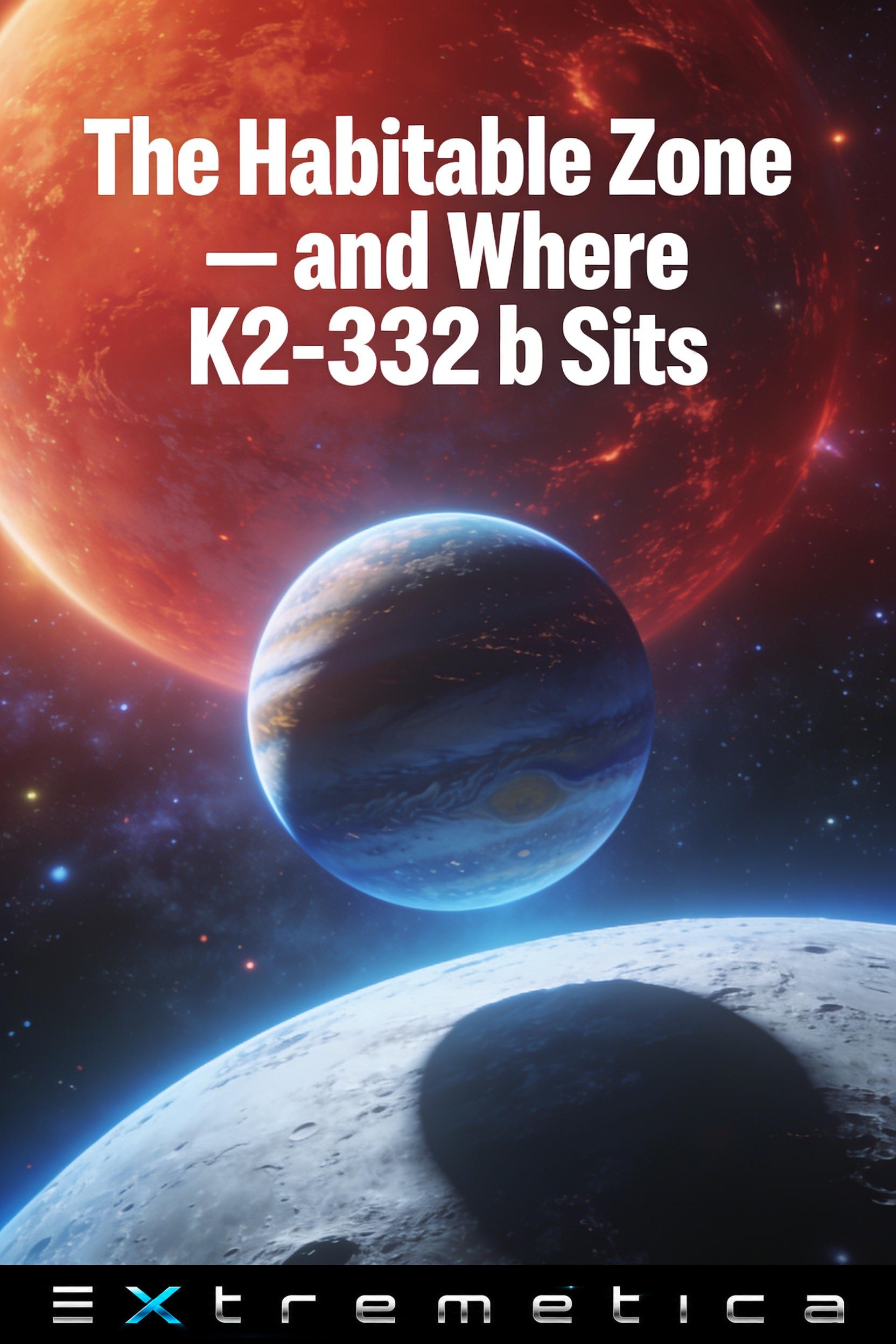
The habitable zone is the band around a star where conditions might allow liquid water to exist on a planet’s surface. It is sometimes called the “Goldilocks zone” — not too hot, not too cold. Being inside this zone does not mean a planet has water or life. It simply means the temperature range makes liquid water possible, if other conditions are right too.
The estimated surface temperature of K2-332 b is about 266 K, which is roughly -7 degrees Celsius. That is just below the freezing point of pure water. However, this figure is an equilibrium temperature — a calculation based on how much starlight the planet receives, assuming it spreads that heat evenly and has no atmosphere. A real atmosphere could raise the actual surface temperature through the greenhouse effect, where certain gases trap heat. Earth itself is warmer than its equilibrium temperature for exactly this reason.
So K2-332 b sits tantalizingly close to the range where liquid water could exist. If it has the right kind of atmosphere, surface temperatures could climb above freezing. If it has little or no atmosphere, the surface could be cold and dry. We simply do not know yet. You can explore how scientists calculate these zones using our habitable zone guide, and compare K2-332 b with other candidates on our most Earth-like worlds list.
What We Still Don’t Know
The honest answer is that there is a great deal still to learn about K2-332 b. Scientists have not yet measured its atmosphere — or confirmed it even has one. Without that information, questions about temperature, weather, and habitability stay open. We also do not know the planet’s exact composition or whether it carries liquid water in any form.
So far, only one planet has been found in the K2-332 system. That could change with more observations. Many star systems turn out to have several planets once telescopes look carefully enough.
K2-332 b is 402 light-years away — close enough to study with current and future telescopes, but far enough that the details come slowly. What we have right now is a world that sits in a genuinely interesting place: large enough to hold onto some kind of atmosphere, cool enough that water is not instantly vaporized, and orbiting a star that fills the galaxy by the billions. That is a good place to keep watching.