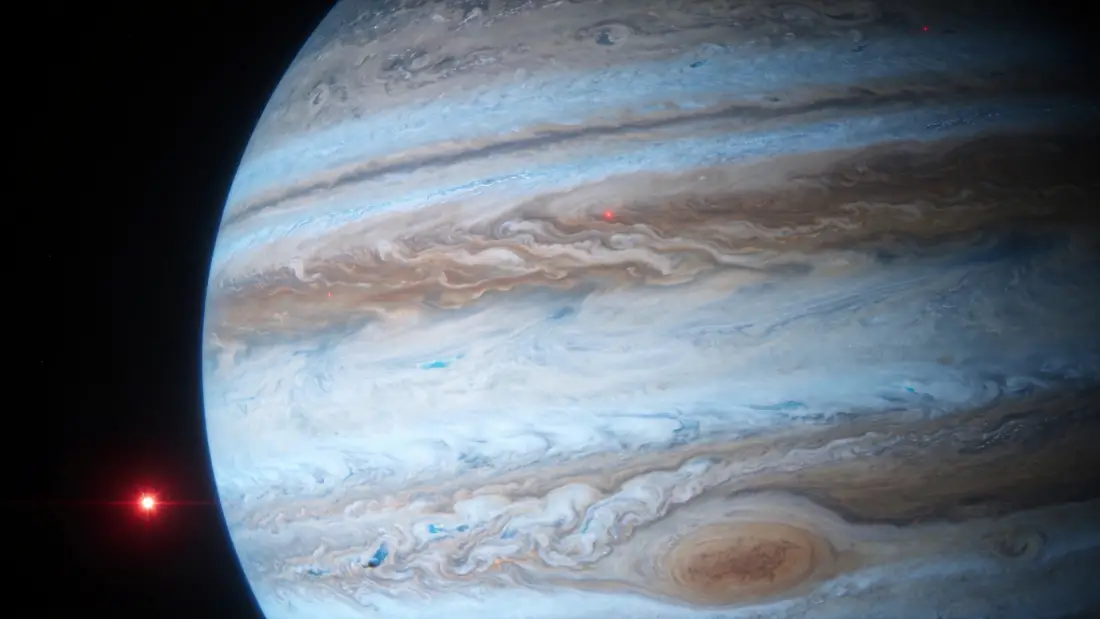
TOI-1227 b is an exoplanet — a planet orbiting a star outside our solar system — sitting about 328 light-years from Earth. Scientists found it in 2022, and it raises a natural question: could a world like this ever support life? To answer that, we first have to ask whether it sits in the right place around its star.
What Kind of World Is TOI-1227 b?
TOI-1227 b is a very large planet. Its radius — the distance from its center to its surface — is about 9.57 times wider than Earth’s. That puts it closer in size to Neptune or Saturn than to our own rocky home.
Its mass, meaning how much material it contains, is about 66.5 times greater than Earth’s. That is a lot. When a planet is both very wide and very heavy, scientists start to think it is probably not a rocky world with dry land. It is more likely wrapped in thick layers of gas or ice, a bit like the giant planets at the outer edge of our own solar system.
One orbit around its star takes only 27.4 Earth days. So a year on TOI-1227 b passes in less than one of our months.
The Star It Orbits
TOI-1227 b orbits a star called TOI-1227. That star has a surface temperature of 3,072 K. For comparison, our Sun’s surface sits at around 5,778 K, so TOI-1227 runs much cooler. A star this cool is called a red dwarf — a type of star that is smaller, dimmer, and redder than our Sun.
Red dwarfs are the most common kind of star in our galaxy. Because they burn their fuel slowly, they can live for hundreds of billions of years — far longer than stars like the Sun. Scientists are very interested in red dwarfs because so many planets have been found orbiting them, and some of those planets sit at distances where temperatures could, in theory, allow liquid water.
The dimness of a red dwarf matters a lot. Because TOI-1227 puts out less heat and light than our Sun, a planet has to orbit quite close to it to receive enough warmth. TOI-1227 b’s short 27.4-day orbit makes sense in that context — it is sitting close to a cool, faint star.
How Scientists Found It

TOI-1227 b was discovered in 2022 using the transit method. This technique works by watching a star’s brightness very carefully over time. When a planet passes in front of its star — this is called a transit — it blocks a tiny amount of starlight. The star looks a little dimmer for a short while, then returns to normal. By measuring how much the light drops and how often it happens, scientists can work out a planet’s size and how long its orbit takes.
The transit method is one of the most successful tools we have for finding exoplanets. It does not require us to see the planet directly, which is helpful because planets are tiny and faint compared to stars. The name TOI stands for TESS Object of Interest, which means the planet was flagged by the TESS space telescope — a telescope designed specifically to hunt for planets using this method.
The Goldilocks Zone Explained
The habitable zone is the band of space around a star where conditions might allow liquid water to exist on a planet’s surface. It is often called the Goldilocks Zone — not too hot, not too cold, but just right. The name comes from the old fairy tale.
Liquid water is important because, as far as scientists know, all life on Earth depends on it. If we are looking for life elsewhere, finding places where liquid water could exist seems like a good place to start. However, “being in the habitable zone” does not mean a planet definitely has water, or an atmosphere, or life. It simply means the distance from the star is not obviously too close or too far for surface water to be liquid — if other conditions also cooperate.
The habitable zone sits at a different distance for every star. Around a hot, bright star it is farther out. Around a cool red dwarf it is much closer in. You can explore how this works using our Habitable Zone explorer.
Where TOI-1227 b Sits in the Zone
The estimated temperature of TOI-1227 b is about 244 K, which works out to roughly -29 degrees Celsius. That is colder than most places on Earth, closer to what you might find in Antarctica in winter.
This temperature estimate is what scientists call an equilibrium temperature — a rough calculation of how warm a planet should be based purely on how much energy it receives from its star. It does not account for a greenhouse effect, where gases in an atmosphere trap heat and warm a planet further. Earth’s own equilibrium temperature would be well below freezing without our atmosphere’s greenhouse effect pushing it warmer.
At 244 K, TOI-1227 b sits near or perhaps just outside the cooler edge of where liquid water is usually considered possible. Scientists have not confirmed whether it falls strictly inside or outside its star’s habitable zone — that boundary depends on factors, like the planet’s atmosphere, that we have not yet measured.
Why Size and Mass Change the Picture
Even setting the temperature question aside, TOI-1227 b’s great size and mass create a separate challenge for habitability. A planet nearly ten times wider than Earth and more than sixty times as heavy is unlikely to have a firm rocky surface like our own. It probably has a deep, dense atmosphere — or is dominated by ice and gas layers throughout.
Life as we know it needs a surface, liquid water, and an energy source. On a world built more like a gas or ice giant, we currently have no model for how that would work. That does not mean life there is impossible — science is humble about what it does not yet know — but it is a significant complication.
If you are curious about worlds that look more genuinely Earth-like, our Most Earth-Like Worlds list is a good place to explore the current leading candidates.
Questions Still Waiting for Answers
There is a lot we do not yet know about TOI-1227 b. Scientists have not measured its atmosphere, its surface conditions, or its exact composition. We do not know if it has moons, rings, or any geological activity. The exact boundaries of TOI-1227’s habitable zone have not been published in our data, so we cannot say with confidence whether TOI-1227 b falls inside or outside it by a precise amount.
This kind of uncertainty is normal and honest. Most exoplanets are known only in outline — a size here, a mass there, a rough temperature estimate. The details that would really answer habitability questions, like what gases are in the atmosphere, require follow-up observations that take time and powerful instruments to carry out.
TOI-1227 b is a fascinating and somewhat puzzling world. Its temperature hint at cool, borderline conditions, but its enormous size suggests it is very different from Earth in ways that matter. Whether it sits in the Goldilocks Zone in any meaningful sense remains, for now, an open question — and that is precisely what makes it worth watching.